










Aerator Subnav
 Instantaneous gas–liquid reaction diffuser
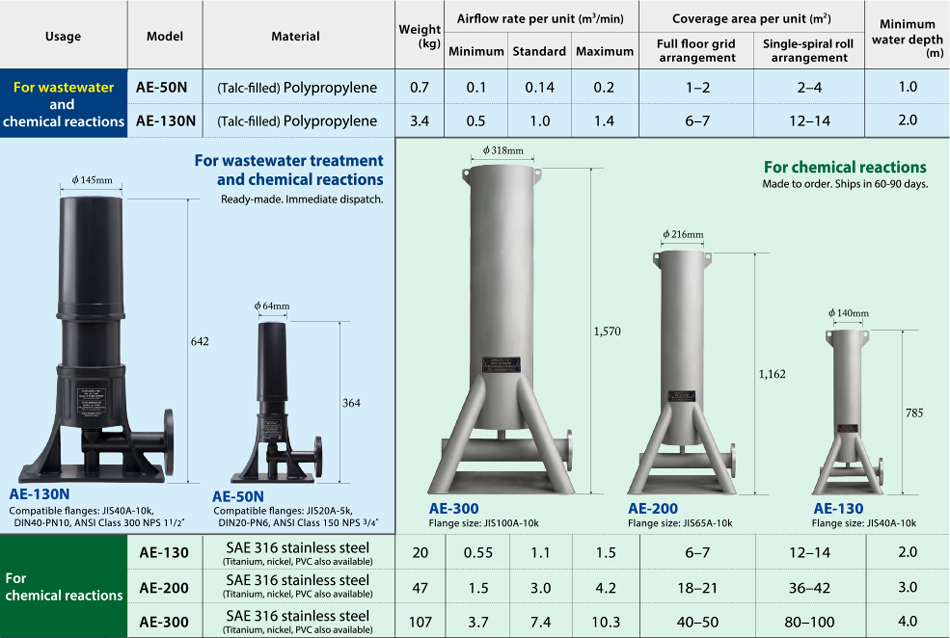
Specifications
Oxygen Transfer Efficiency (OTE) and airflow resistance
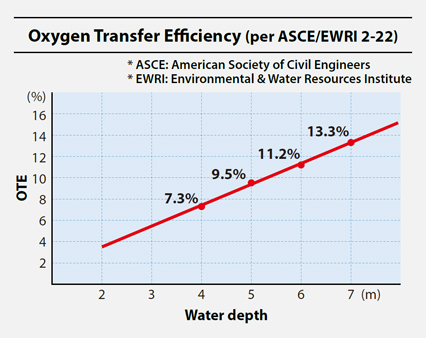
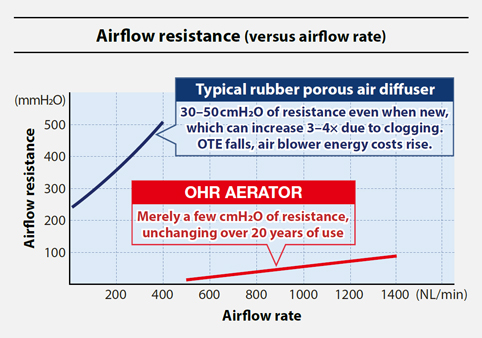

Because the OHR AERATOR has an alpha factor of approximately 1.0, the above OTE values apply directly to actual wastewater.
By contrast, the OTE of conventional diffusers becomes significantly ‘discounted’: in sewage it falls by around 40–60%, and in industrial wastewater by more than 70–80%.
ASCE/EWRI 2-22 is a globally-adopted US standard that establishes standardized methods for testing the OTE of air diffusers.
The procedure is highly robust: it involves verifying the uniform distribution of dissolved oxygen (DO) using at least four DO meters placed throughout the upper, middle and lower sections of the tank, as well as taking the average of at least three replicate tests for each water depth.
Testing to this standard was carried out by a third party in Europe, the results of which led to some minor revisions to the in-house measurements we had been using.
For chemical reactions and special usages
Examples of use in accelerating chemical reactions
- Chemical reaction acceleration (gas–liquid, liquid–liquid, solid–liquid)
As part of the chemical production line - Oxidation of waste liquid from flue gas desulfurization
Aerating to oxidate SO₃ to SO₄ - Accelerating Fenton’s reaction
Mixing and churning to prevent the accumulation of precipitate - Neutralization
Powerful mixing to prevent rapid fluctuations in pH - Gas absorption
Incorporating toxic gases into liquids; producing calcium carbonate by reacting limewater with the CO₂ in exhaust gas
- Degassing
Removal and discharge of VOCs (Volatile Organic Compounds), ammonia, etc - Other
Improving poor mixing
Examples of specialized usage
- Aeration of white water at a paper mill
Preventing decomposition, anaerobic growth and the generation of hydrogen sulfide - Prevention of sludge accumulation
Preventing heavy material from accumulating on the tank floor - Aeration tank load reduction
Oxygen enrichment in a raw water tank and equalization tank - Oxygen enrichment of hypoxic water
Increasing oxygen levels in dams, lakes, marshes and ponds; promoting turnover - Oxygen enrichment of aquaculture water
Increasing oxygen levels in aquaculture and irrigation water; finely dispersing micronutrients such as minerals - Membrane flushing
Powerful aeration to inhibit membrane fouling - Acceleration of cultivation and fermentation
Accelerating cultures in the food and pharmaceutical industries, among others; accelerating various kinds of fermentation - Fermentation broth churning
Evenly stirring and uniformly mixing fermentation broths and mashes, such as for Japanese saké - Other
Improving poor mixing